Burnout Is a Systems Problem: Most Women Are Missing the System
Apr 15, 2026⏱ 9-minute read/audio summary

Burnout is not a single event. It is a progressive adaptation to sustained demand. Over time, cumulative demand creates measurable physiological strain across systems.¹ Burnout has been incorrectly framed as lack of discipline, poor time management, inconsistent habits, and insufficient motivation. Most high-performing women are operating without a system to manage it. So the solutions follow the same flawed logic — optimize your routine, stack more habits, try a new supplement, push harder.
But this model collapses under real physiology. The body does not operate on motivation. It operates on regulation.
Key Takeaways
In this article, you’ll learn:
- Burnout is not caused by one factor. It is the result of accumulated metabolic load across systems
- Burnout is not an energy deficiency but a biological overload
- The body does not “run out” of energy, it downregulates output under sustained metabolic load
- High-achieving women accumulate metabolic debt through chronic cognitive, emotional, and physiological demand
- The nervous system acts as the control center, not motivation and not willpower
- Sustainable performance requires system-level regulation rather than surface-level optimization
- The missing piece in modern wellness is infrastructure: a Metabolic Operating System
The Misdiagnosis of Burnout
Under sustained demand, multiple systems begin to shift. The nervous system experiences increased sympathetic load with reduced parasympathetic recovery. The metabolic system shows impaired glucose regulation and mitochondrial strain. Cognitive function shows reduced executive capacity and mental fatigue. Hormonal pattern stability becomes disrupted as the HPA axis and endocrine regulation are affected by chronic activation — women noticing significant hormonal pattern changes are encouraged to work with their healthcare provider for individualized evaluation. Under chronic stress, the body diverts energy toward maintaining stability, increasing the energetic cost of regulation and reducing what is available for performance.¹
Metabolic Load Theory™: A Systems Model of Burnout
High-achieving women are not underperforming. They are overloaded.
The Metabolic Load Theory™ model builds on emerging research in stress physiology and allostatic load and extends it into a practical systems framework for high-performing individuals. Metabolic Load is the cumulative physiological demand placed on the body plus the energetic cost required to maintain stability under that demand.
High performers carry cognitive load in the form of decision-making and responsibility, emotional load through caregiving, leadership, and performance pressure, and physiological load from sleep disruption, under-recovery, and inflammation. Load is not abstract. It is biologically measurable.² ³
With time, this cumulative demand creates measurable strain across systems from hormonal pattern stability to cellular energy pathways.⁴ And the body responds exactly as it is designed to — it reduces output. Energy drops. Focus declines. Motivation disappears.
Your body is not failing to produce energy. It is strategically reducing output in response to accumulated physiological strain. Not because something is broken, but because the system is protecting itself.
Most wellness strategies target inputs such as nutrition and supplements, or outputs such as productivity and workouts. Very few target the system regulating both. This is why high performers say: "I'm doing everything right and still feel off." High performance does not fail from lack of effort. It fails when biological capacity is exceeded.
The Missing Infrastructure: A Metabolic Operating System
Every high-performing system runs on an operating system. Your body is no different.
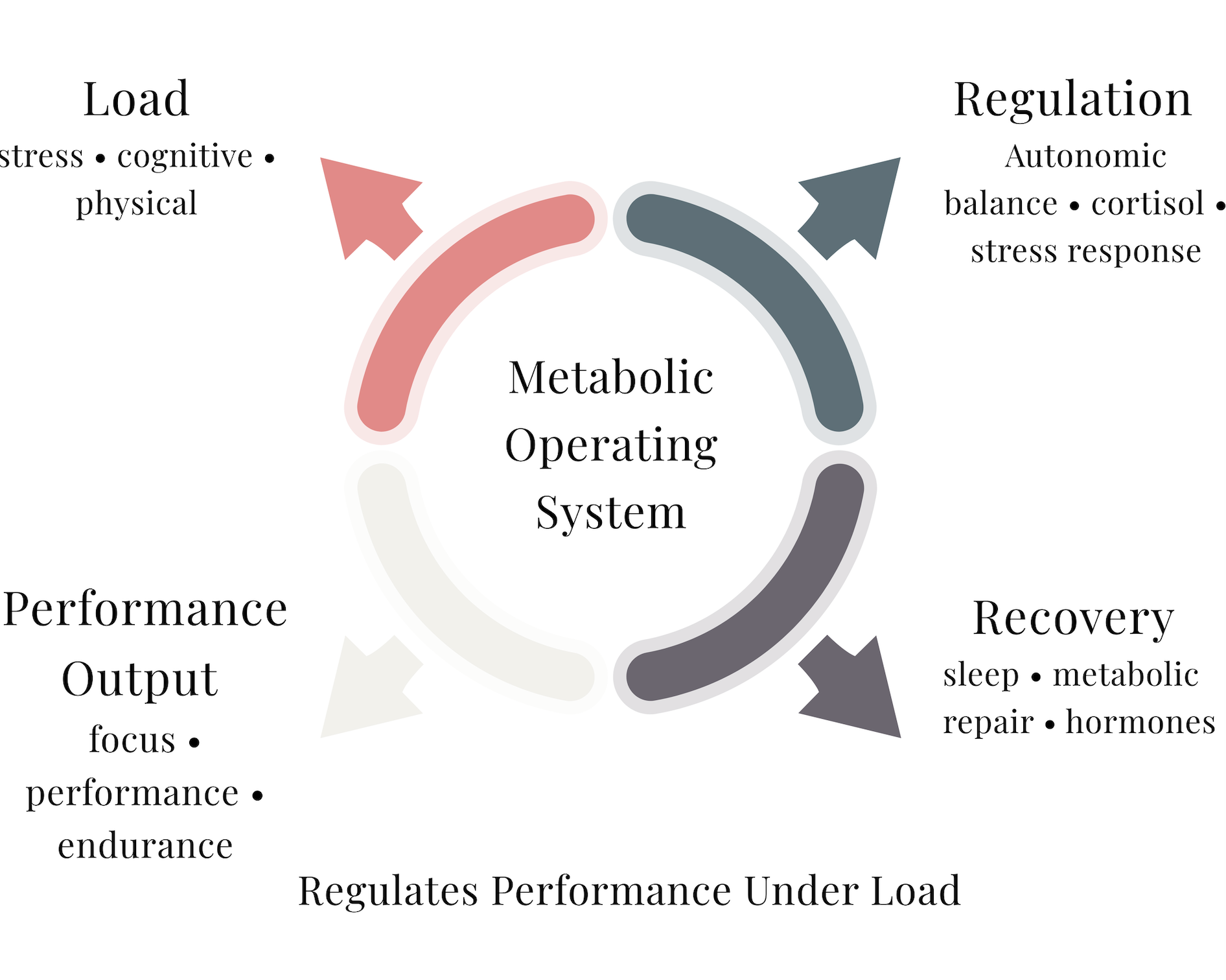
The metabolic operating system governs energy allocation, stress response, recovery signaling, hormonal pattern stability, and cognitive performance. It determines when you feel energized, when you feel exhausted, when the body pushes forward, and when it forces you to stop. If this system is dysregulated, no amount of optimization will override it.
The Nervous System: Your Executive Control Center
The nervous system is not just involved in stress. It is the command center of performance. It decides whether energy is available, whether recovery is prioritized, and whether the body perceives safety or threat. This is why high-achieving women can maintain discipline, execute at a high level, and continue producing while simultaneously experiencing exhaustion, dysregulation, and declining resilience. Execution is being sustained at the expense of regulation.
Under sustained stress, signaling pathways in the brain can impair prefrontal cortex function — the area responsible for focus, planning, and high-level decision-making.⁴
From Energy Management to System Regulation
This is the shift most people never make. They try to manage energy with more sleep, better food, and improved routines. But high performance requires something deeper: system regulation. This means reducing metabolic load, increasing recovery capacity, restoring nervous system balance, and stabilizing physiological signaling.
Recovery capacity determines resilience. If your success has outpaced your recovery capacity, your body will eventually intervene — not as failure, but as protection. The goal is not to push harder. It is to build a system that can sustain your level of output.
High performance without recovery creates metabolic debt. And metabolic debt compounds.
The Metabolic Operating System Lens
The metabolic operating system (MOS) provides the educational infrastructure for understanding burnout as a systems problem rather than a symptoms problem.
Load processing is where the accumulation of cognitive, emotional, and physiological inputs is managed. When load consistently exceeds processing capacity, every other pillar is affected.
Nervous system regulation is the command pillar. Without adequate regulation here, the system cannot allocate energy appropriately across any domain including performance, recovery, or basic function.
Recovery and restoration is where capacity is rebuilt. Without this pillar functioning, the other three cannot reset between demand cycles. Most women reduce their burnout by neglecting this pillar while adding more to the others.
Performance sustainment is the output of a well-regulated system. It is not achieved by pushing harder within a dysregulated system. It is the natural result of the first three pillars being consistently supported.
Rebuilding the System
At a systems level, recovery requires three shifts. The first is to reduce load by identifying and removing unnecessary physiological stressors before adding anything new. The second is to restore regulation by supporting nervous system balance and allowing hormonal pattern stability to return and in partnership with a healthcare provider where indicated. The third is to rebuild capacity by increasing the body's ability to recover and perform rather than simply performing through depletion.
This is not a quick fix. It is infrastructure. Most women are attempting to optimize within a system that is already dysregulated. Optimization does not fix instability. Systems do. This is the difference between temporary improvement and sustainable performance.
Ready to See Your System Clearly?
Most high-achieving women do not have random symptoms. They have patterns. The Metabolic Resilience Audit identifies where your system is overloaded and where capacity is breaking down and giving you a starting point that is specific to your biology, not generic to everyone.
Take the Metabolic Resilience Audit
This framework reflects current research across metabolic physiology, neuroendocrinology, and stress adaptation.
References
- Bobba-Alves, N., et.al., (2022). The energetic cost of allostasis and allostatic load. Psychoneuroendocrinology, 146, 105951. https://doi.org/10.1016/j.psyneuen.2022.105951
- Serviant-Fine, T., et al., (2024) Allostatic load: historical origins, promises and costs of a recent biosocial approach. BioSocieties 19, 301–325 (2024). https://doi.org/10.1057/s41292-023-00303-0.
- García, A.M.G., et al., (2025), Allostatic Load as a Short-Term Prognostic and Predictive Marker. Stress and Health, 41: e3527. https://doi.org/10.1002/smi.3527.
- Venkatesan, S., et al., (2026). Mitochondrial Dysfunction: The Cellular Bridge from Emotional Stress to Disease Onset: A Narrative Review. Biomolecules, 16(1), 117. https://doi.org/10.3390/biom16010117 .
Stay connected with news and updates!
Join our mailing list to receive the latest news and updates from our team.
Don't worry, your information will not be shared.
We hate SPAM. We will never sell your information, for any reason.