Burnout Isn’t an Energy Problem — It’s a Metabolic Load Problem
Mar 15, 2026⏱ 10-minute read/audio summary

Burnout is often framed as a personal failure. The assumed solutions sound familiar: be more consistent, fix your routine, try a new supplement, or push through. This model ignores physiology. For many high-achieving women, the issue is not effort. It’s that the body has been operating under sustained, unregulated load over time.
High-performing women often operate under constant cognitive demand, emotional responsibility, pressure to maintain performance and inconsistent recovery³. They don’t stop. They adapt. And for a long time their body keeps up. Until it does not.
Key Takeaways
In this article, you’ll learn:
- Burnout is not a failure of discipline, it is a physiological response to accumulated metabolic load
- Why early burnout symptoms appear before exhaustion
- How High-achieving women face sustained cognitive, emotional, and physiological demand that accumulates differently than standard stress
- Why the nervous system reduces energy output as a protective mechanism rather than a failure
- Why recovery requires reducing load and restoring capacity rather than pushing harder
What Is Metabolic Load? The Missing Framework
Metabolic load refers to the total physiological burden placed on the body over time. It includes chronic stress exposure, blood sugar instability, sleep disruption, inflammation, hormonal pattern fluctuation, and cognitive and emotional demand. Individually, these may seem manageable. Cumulatively, they create system-wide strain.
Metabolic load is the practical, real-world expression of what research describes as allostatic load — the measurable physiological cost of maintaining stability under sustained demand¹. When the body can no longer maintain balance, it shifts into protective adaptation. This is where burnout begins. Not as collapse, but as compensation. The body adapts before it collapses. 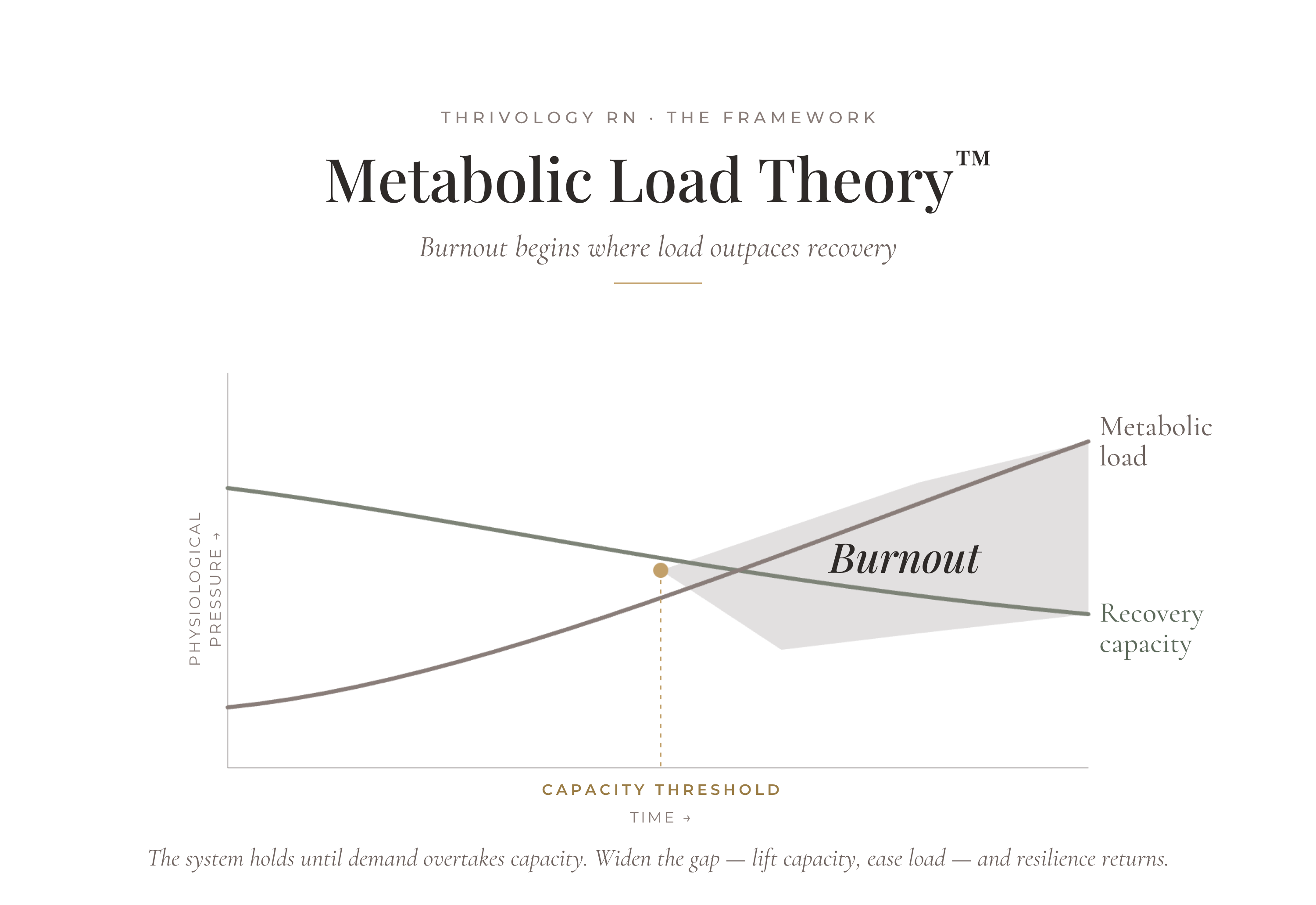
Metabolic Load Theory™ (MLT™) is the clinical framework underlying this post. The diagram above maps how it works: multiple physiological inputs including cognitive demand, emotional load, blood sugar instability, sleep disruption, and inflammatory burden — converge over time into cumulative systemic strain. What makes MLT™ distinct from conventional burnout models is its emphasis on the energetic cost of stability: maintaining equilibrium under sustained demand is itself a measurable metabolic expense.¹ The diagram traces this accumulation from input convergence through compensatory adaptation to the threshold where the system can no longer sustain high function and identifies where load reduction and capacity restoration become the clinical priority.
Not All Metabolic Load Looks the Same
Metabolic load does not accumulate the same way for every person. Most women carry a dominant pattern. Cognitive load dominance shows up as constant decision-making, task switching, and mental overwhelm². Physiological load dominance reflects poor sleep, blood sugar instability, and inflammation. Emotional load dominance comes through caregiving, leadership responsibility, and relational stress. For most high-achieving women, it is a combination — but one pattern usually leads.
There are three ways burnout develops. The first is high load meeting normal capacity, then a sudden life demand spike. The second is normal load meeting reduced capacity, which occurs when poor sleep, hormonal pattern disruption, and chronic under-recovery deplete the system's ability to absorb everyday demands. The third is the most common pattern: high load meeting low capacity simultaneously. Sustained stress compounded by a depleted system.
Many women attempt to recover by simply adding rest. But if metabolic load remains elevated, recovery never fully consolidates. This is why a person can sleep and still feel exhausted, take time off and still feel depleted. Recovery only works when load is simultaneously reduced and capacity is actively restored.
Burnout Physiology: What’s Actually Happening in the Body
At a systems level, burnout reflects disruption across three primary areas.
Nervous system regulation is typically the first to signal strain. Chronic stress increases sympathetic activation. Over time, recovery becomes impaired, baseline tension increases, and the nervous system loses flexibility. Eventually the body may shift into fatigue, reduced output, and diminished motivation. This is not dysfunction. It is energy conservation.
Metabolic signaling and energy stability are affected by sustained stress as insulin patterns become dysregulated, glucose variability increases, and energy production becomes less efficient. This creates brain fog, unstable energy, cravings, and reduced cognitive clarity — patterns that are often attributed to motivation rather than metabolic function.
Hormonal pattern and recovery disruption reflects the downstream effects of chronic physiological load on cortisol rhythm, sleep architecture, and reproductive hormone pattern stability. This can contribute to disrupted sleep quality, increased irritability, and the characteristic "wired but tired" pattern. Women experiencing significant hormonal pattern disruption are encouraged to work with their healthcare provider, as the clinical picture requires individualized assessment beyond load reduction alone.
A Metabolic Operating Lens on Burnout
The Metabolic Operating System (MOS) provides an educational framework for understanding how burnout develops across interconnected systems rather than as a single-system failure.
Load processing reflects the body's ability to handle metabolic inputs including blood sugar, inflammatory load, and nutritional demand. When load consistently exceeds processing capacity, the entire system shifts toward compensatory output — generating the physical symptoms of burnout even before emotional exhaustion is recognized.
Nervous system regulation is the MOS pillar most directly responsible for the transition from high performance to depletion. The nervous system operates as the command structure determining whether energy is allocated toward output or toward recovery. Unsupported nervous systems eventually override willpower.
Recovery and restoration is the pillar that determines whether the other three can function. Without consistent, quality sleep and physiological downregulation, the system cannot clear load or rebuild capacity. Most burnout-oriented recommendations fail because they address outputs without restoring this pillar first.
Performance sustainment is only achievable when the first three pillars are functional. High performance without recovery creates metabolic debt. The debt eventually becomes a bill the body presents and by the time it does, the interest has been accumulating for years.
For most women, these changes do not happen all at once. They build gradually. Burnout rarely begins with exhaustion. It starts with brain fog, disrupted sleep, lower frustration tolerance, and a wired-but-tired quality that feels unfamiliar. These are not random symptoms. They are early signals of rising metabolic load.
When metabolic load becomes too high, the body prioritizes survival over performance. Output drops. Focus declines. Motivation fades. Not because you are lazy, but because your system is protecting capacity.
What Actually Works: Reducing Metabolic Load
Pushing back harder typically backfires. Most conventional recovery strategies increase demand — stricter routines, more workouts, more discipline. When load is already elevated, this increases physiological strain, delays recovery, and worsens the burnout pattern over time.
Burnout recovery begins by shifting from output-driven strategies to load management and capacity restoration. This includes stabilizing blood sugar as the first metabolic input, improving sleep quality as the primary recovery mechanism, regulating nervous system activation through consistent parasympathetic inputs, and reducing unnecessary physiological stressors before adding any new protocol.
Sustainable recovery happens when the body experiences safety, restores regulation, and rebuilds capacity over time. Recovery is not about doing more. It is about reducing what the system can no longer sustainably absorb.
A starting framework: identify where load is highest (sleep, stress, nutrition, or schedule), reduce one input variable rather than overhauling everything simultaneously, and support recovery before increasing any demand. Small shifts create system-wide change.
Ready to Understand What Is Actually Driving Your Load?
Most burnout advice stays at the surface — habits, routines, or motivation. The Metabolic Resilience Audit is an RN-designed assessment that identifies where your system is carrying the highest load and where recovery capacity is breaking down — giving you pattern clarity rather than generic recommendations.
Take the Metabolic Resilience Audit
This framework reflects current research across metabolic physiology, neuroendocrinology, and stress adaptation. Updated for editorial clarity and current metabolic resilience research: May 2026.
References
- Bobba-Alves, N., Juster, R. P., & Picard, M. (2022). The energetic cost of allostasis and allostatic load. Psychoneuroendocrinology, 146, 105951. https://doi.org/10.1016/j.psyneuen.2022.105951.
- Salvagioni DAJ, et. al. Physical, psychological and occupational consequences of job burnout: A systematic review of prospective studies. PLOS ONE. 2017;12(10):e0185781. https://doi.rog/10.1371/journal.pone.0185781.
- McVicar A. Workplace stress in nursing: a literature review. J Adv Nurs. 2003 Dec;44(6):633-42. https://doi.org/10.1046/j.0309-2402.2003.02853.x
Stay connected with news and updates!
Join our mailing list to receive the latest news and updates from our team.
Don't worry, your information will not be shared.
We hate SPAM. We will never sell your information, for any reason.