Metabolic Resilience for High-Achieving Women
Jul 15, 2025⏱ 9-minute read/audio summary

Most advice for high-achieving women dealing with burnout focuses on doing less: fewer commitments, more rest, quieter weekends. That guidance is not wrong. It is incomplete. What it misses is what lies underneath the exhaustion. Sustained demand reshapes energy production, cortisol rhythm, hormonal signaling, glucose regulation, and nervous system function long before a woman reaches the point of collapse.
Burnout is not a motivation failure. It is not a scheduling problem. For many high-achieving women, it is the predictable outcome of a metabolic system operating under chronic load without proportional recovery. Understanding that distinction does not just change how you think about burnout. It changes how you approach recovery.
Key Takeaways
- Burnout is often a metabolic load problem before it becomes emotional exhaustion.
- High-achieving women frequently normalize early physiological signs of overload.
- Recovery capacity determines resilience, not willpower.
- Hormones are responsive to stress physiology, sleep architecture, inflammation, and nervous system signaling.
- The body adapts long before it collapses. Adaptation is not the same as health.
- Metabolic resilience is the foundation for sustainable performance.
What Metabolic Resilience Actually Means
Metabolic resilience reflects the body's capacity to adapt to stress while maintaining stable energy output, glucose regulation, hormonal signaling, cognitive performance, and recovery capacity. Under chronic load, the body reallocates resources toward short-term survival rather than long-term optimization. Sleep architecture changes. Cortisol rhythm shifts. Blood sugar becomes less stable. Recovery becomes less efficient. The system adapts before symptoms become obvious.
When metabolic resilience is intact, energy output is stable across the day. Cognitive performance holds under pressure. Hormonal patterns remain consistent. The body moves between demand and recovery without accumulating physiological debt.
When metabolic resilience is eroded, the early signals are often subtle:
- afternoon energy instability and difficulty sustaining focus¹
- increased cravings for sugar or highly palatable foods
- worsening PMS or hormonal irregularity²
- disrupted sleep despite physical fatigue³
- feeling simultaneously exhausted and overstimulated at night
These are not character flaws. They are physiological signals and they often reflect cumulative metabolic load exceeding the system's current recovery capacity.
Why High-Achieving Women Burn Out Faster
High-achieving women in healthcare and business frequently operate inside chronic physiological demand without recognizing how much recovery capacity has already been depleted. In clinical and corporate environments, performance is maintained through caffeine, shortened sleep, irregular fueling patterns, sustained cognitive load, and prolonged sympathetic activation. The system compensates remarkably well, until it no longer can.
High performance without recovery creates metabolic debt. The challenge for high-achieving women is that tolerance for discomfort, sustained output, and the ability to override fatigue signals all make it possible to extend that compensation far longer than physiology supports. By the time distress is undeniable, significant debt has already accumulated.
Chronic stress does not just feel difficult. It directly influences metabolic function. Research in metabolic health indicates that sustained physiological threat disrupts the body's ability to regulate energy, hormonal signaling, and cellular function efficiently4. The body adapts before it collapses. Adaptation is not the same as thriving.
A Metabolic System Lens
At Thrivology RN, the framework used to understand how the body functions under sustained demand is called the metabolic operating system (MOS). It is not a diagnostic tool. It is an educational systems lens: a structure for identifying patterns, supporting recovery, and rebuilding physiological capacity in a coaching context.
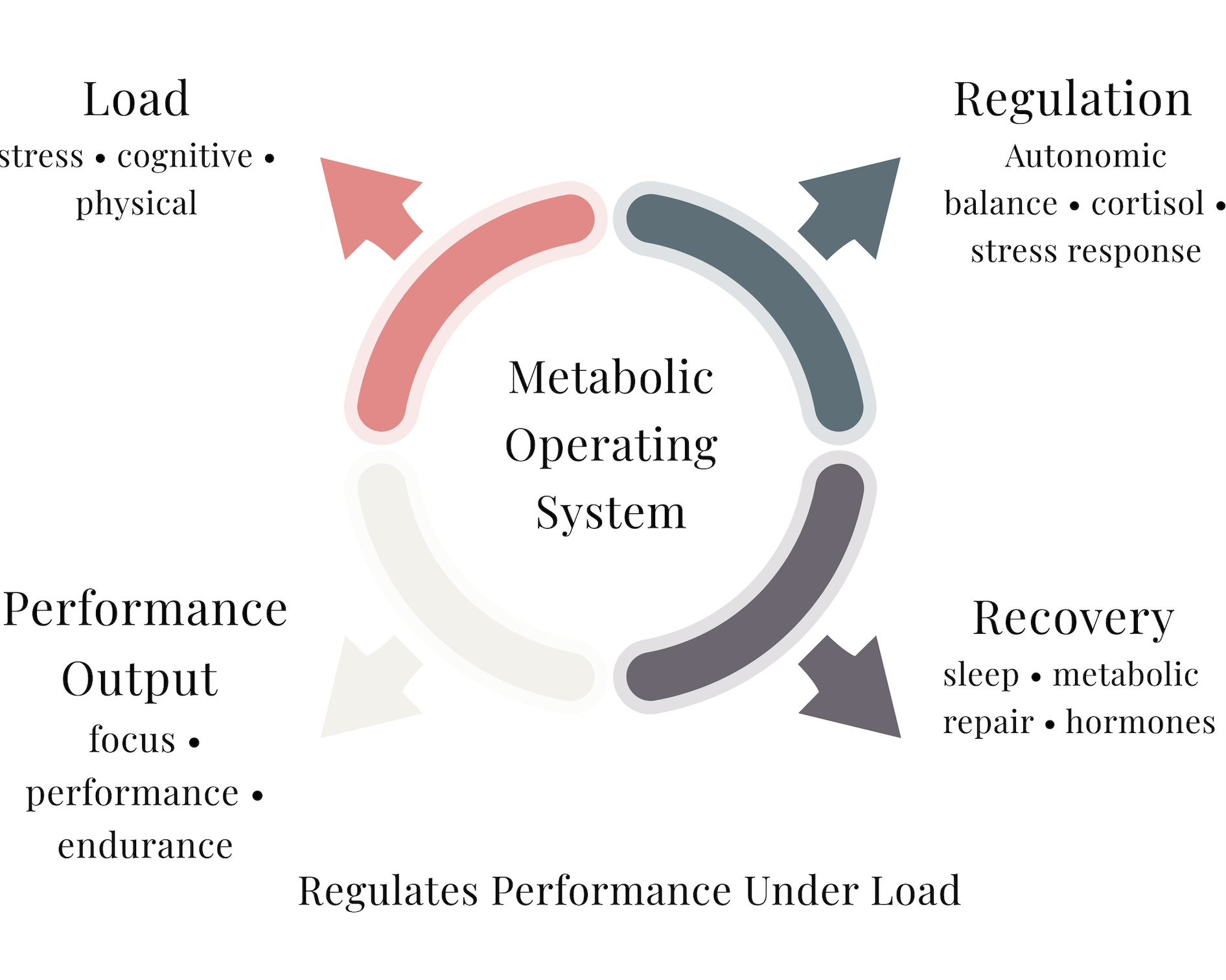
The MOS consists of four core systems:
- Load Processing: how the body receives, interprets, and responds to physical, cognitive, emotional, and environmental demands.
- Nervous System Regulation: how the autonomic nervous system navigates between activation and recovery states.
- Recovery Restoration: how the body rebuilds and restores resources between demands.
- Performance Sustainment: how energy, focus, and sustained output are maintained over time.
For most high-achieving women presenting with burnout, all four systems are under simultaneous strain. Load processing is overwhelmed. The nervous system is weighted toward activation. Recovery restoration is inadequate. And performance sustainment is increasingly dependent on compensation rather than genuine physiological capacity.
Your body is not a willpower problem. It is an operating system. Operating systems respond to inputs, not intentions.
How to Think About Metabolic Resilience
Rebuilding metabolic resilience begins with assessment before optimization. Most high-achieving women approach burnout the same way they approach professional challenges: with more effort, more protocols, more discipline. The MOS framework suggests a different starting point.
Before adding interventions, identify where the four systems are most strained.
Where is load accumulating without adequate recovery? Consider sleep duration and quality, fueling consistency, cognitive demands, and environmental stressors that have no recovery counterpart.
What is the current state of nervous system regulation? Consider the ability to genuinely downshift between demands, recovery windows, and parasympathetic access outside of sleep.
How much genuine restoration is occurring between demands? Consider whether movement is restorative or an additional demand, nourishment patterns, and the quality of off-time.
What is currently sustaining performance, genuine physiological capacity, or compensation? Consider reliance on stimulants, energy patterns across the day, and what happens when caffeine or adrenaline is removed.
These are not prescriptions. They are assessment questions. Pattern recognition comes before protocol design.
The Cost of Compensation
There is a specific physiological risk for high-achieving women that rarely gets named directly: the more capable a woman is, the longer she can sustain compensation. The nurse working three 12-hour shifts while managing a household and a side project can often function, by surface measures, far longer than her physiology supports. By the time the system signals distress clearly enough to be undeniable, significant physiological debt has already accumulated.
Compensation is a temporary strategy, not a sustainable state. Recognizing that is not a reason for alarm. It is a reason for a different approach to support, one built around recovery capacity and physiological foundations rather than willpower or optimization.
Metabolic resilience is not a personal achievement. It is a physiological foundation. Without it, sustainable performance in any domain becomes increasingly dependent on override rather than capacity.
Understanding Your Metabolic Patterns
High-achieving women often normalize physiological signals of overload long before the system fully compensates. The Metabolic Resilience Audit is a free RN-guided assessment that helps identify patterns across energy, stress physiology, nervous system regulation, and recovery capacity.
Take the Metabolic Resilience Audit →
This framework reflects current research across metabolic physiology, neuroendocrinology, and stress adaptation. Updated for editorial clarity and current metabolic resilience research: May 2026.
References
-
Garbarino S, et al. Role of sleep deprivation in immune-related disease risk and outcomes. Communications Biol. 2021 Nov 18;4(1):1304.https://doi.org/10.1038/s42003-021-02825-4.
-
Brum MCB, et. al. Effect of night-shift work on cortisol circadian rhythm and melatonin levels. Sleep Sci. 2022 Apr-Jun;15(2):143-148. https://doi.org/10.5935/1984-0063.20220034.
-
Marie Vandekerckhove, Raymond Cluydts. The emotional brain and sleep: An intimate relationship. Sleep Medicine Reviews. 2010 August;14(4): 219 226. https://doi.org/10.1016/j.smrv.2010.01.002.
Stay connected with news and updates!
Join our mailing list to receive the latest news and updates from our team.
Don't worry, your information will not be shared.
We hate SPAM. We will never sell your information, for any reason.